50th Anniversary of the Ordination of Women in the Diocese of Kootenay
Kathryn Lockhart, Archivist, Anglican Diocese of Kootenay
On November 30, 1976, fifty years ago, the first women in Canada were ordained as Anglican priests in the Dioceses of Niagara, Huron, New Westminster, and the former Cariboo. By January 1978 there were eighteen women ordained to the priesthood in ten different dioceses.
It was the initiative of the Lambeth Conference of 1968 that put the ordination of women onto the agenda of the Anglican Church of Canada. Primate Howard Clark convened a task force in 1971 comprising both clergy and laity to examine the issue, and a report was submitted to the General Synod by 1973. A motion was passed to accept the principle of the ordination of women to the priesthood, and the matter was referred back to the House of Bishops for discussion.
When the Anglican Church of Canada began to consider the ordination of women, there was a predictable backlash from both clergy and laity nationwide. Unfortunately, the correspondence on this topic is missing from the Diocese of Kootenay archives.
Primate Ted Scott and several other bishops were strongly in favour of the ordination of women to the priesthood. Scott walked a diplomatic tightrope, being committed both to promoting the ordination of women and to maintaining unity within Canada and the larger Anglican Communion. General Synod 1973 had asked dioceses to begin discussing the ordination of women in their own synods while the House of Bishops considered the matter, including discussion with interdenominational colleagues.
In the Diocese of Kootenay, a circular letter was sent to clergy in the fall of 1973 asking for their opinion on the matter. Nine responses are in the archive file – four in favour, and five against. In one of the opposing responses, the writer points out that if women could be ordained priests, then the next step would inevitably be their consecration as Bishops.
Archbishop Scott visited most of the dioceses during the time the issue of the ordination of women was under discussion. Between 1973-1975 Scott visited diocesan synods, but did not push his own agenda. If the synod did not raise the issue, then neither did he.
The Ordination of Women was on the agenda of the 1975 Diocese of Kootenay Synod, to which Scott sent his greetings. However, close to the end of the second day, the Clerical Secretary announced that there was no time left to discuss the topic. The topic did not reappear at subsequent synods, nor was a motion passed by the Executive Committee (now Diocesan Council).
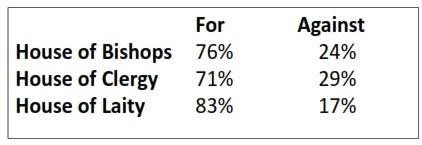
At General Synod June 1975, the votes to accept the principle of the ordination of women to the priesthood were as follows:
Another motion was passed containing a Conscience Clause,** a legal provision permitting individuals or organizations to refuse to perform certain required actions if doing so violates their deeply held beliefs. The conscience clause was for existing clergy (deacons, priests and bishops) only; from that 1975 date on, no clergy could be ordained or bishops elected and consecrated unless they agreed with the ordination of women. This allowed the change to happen gradually and smoothly, until by 1991 every diocese in Canada had ordained a woman.
Throughout discussions on this subject, the bishops were of the opinion that whatever happened, the collegiality of the House would be crucial in steering the church through the decision-making process. By maintaining a united front, although divided in conscience, they were able to provide a model for the larger church which exemplified the possibility of remaining together.
The Rev. Dr. Wendy Fletcher points out that the decision to explore women’s ordination was not a bottom-up democratic movement driven by the laity, but rather a "revolution from above"—an initiative pushed forward primarily by the House of Bishops. She states that there is no record of any formalized lobby in favour of the ordination of women from the grassroots of the church. Likewise, the women who were ordained as priests were not proactive in the promotion of the ordination agenda.
Until 1975, the clergy as a group had not lobbied to prevent the ordination of women. However, in September 1975, a letter signed by a group of more than 200* Anglican clergymen was published in the national church newspaper, the Anglican Churchman (now the Anglican Journal.) The letter, called A Manifesto on the Ordination of Women to the Priesthood from the Concerned Clergy of the Anglican Church of Canada was published with names and dioceses attached.
Archbishop Scott issued a response to the Manifesto dated November 17, 1975 acknowledging the deep struggle and concern over the issue reflected by the signatories. He noted that this was the first time since 1971, when discussions on this issue began, that a formal statement had been made by clergy expressing their displeasure with the movement towards women’s ordination. Scott, noting that clergy had signed the Manifesto for differing reasons, responded systematically to the problems they raised in a tone of pastoral conciliation. In the end, the Manifesto had little impact as there was no organized follow-up by the authors of the document.
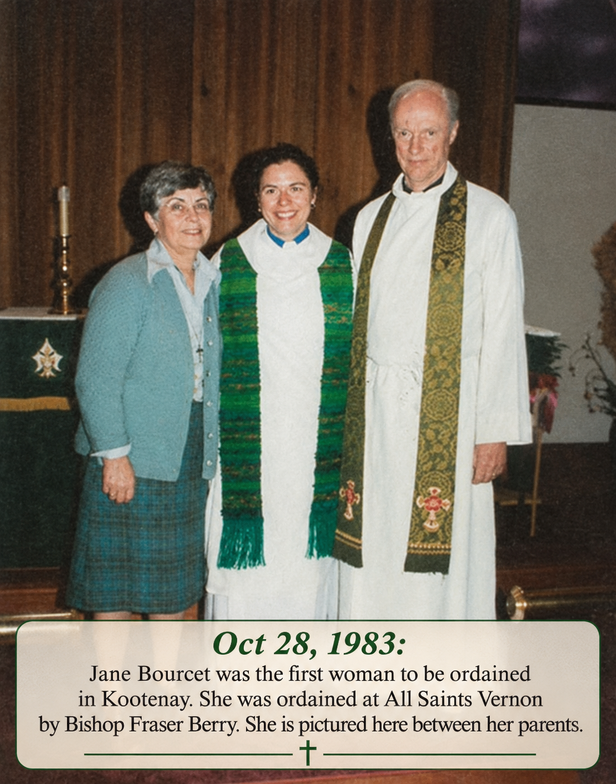
Every diocese in the Anglican Church of Canada has ordained women to the priesthood since 1976. In 1983, The Rev. Jane Bourcet was the first woman to be ordained priest in the Diocese of Kootenay, by Bishop Fraser Berry. Over the last forty-three years, twenty-three women have been ordained priest in Kootenay, eleven of them by Archbishop David Crawley. Their gifts and perspectives have enriched our church, bringing different points of view on scripture, ministry, human relationships and world events.
In July 1965, the editors of the HighWay (four men!) presciently published the following “cartoon:”
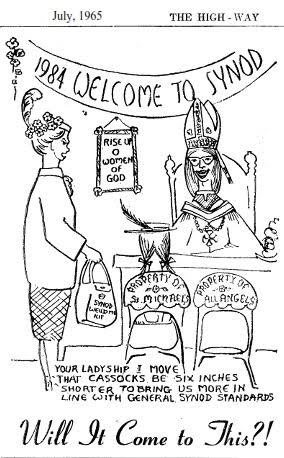
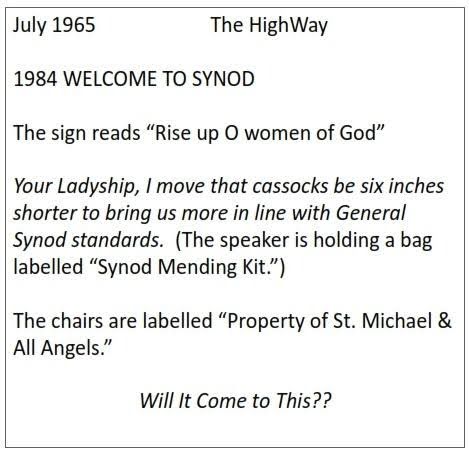
In 1993, the cartoon’s prediction came true, when Victoria Matthews was elected the first woman Bishop of the Anglican Church of Canada.
Bishop Susan Johnson, the first woman to be elected national bishop of the Evangelical Lutheran Church in Canada (ELCIC), says, “I think it’s important to have a variety of leadership, not just male-female, but broader understandings as well, not just of gender but of many other capacities, so that we represent not only the full membership of the church that we’re called to serve, but the world into which God has called us in mission. … If we’re serious about trying to say that this is God’s church, then shouldn’t we look like God’s people?” (Closing the Gender Gap)
____________________
*200 represents less than 10% of the total number of active clergy at the time
** This clause was revoked by the General Synod of 1986.
References
Anglican Diocese of Kootenay Archives.
Fletcher-Marsh, Wendy. (1995). Revolution from Above: Women and the Priesthood in Canadian Anglicanism, 1968-1978. Historical Papers 1995: Canadian Society of Church History, 128-148. Downloaded from York University Website:
https://historicalpapers.journals.yorku.ca/index.php/historicalpapers/article/view/39439
Kidd, Joelle. (March 7, 2019). Closing the Gender Gap in Church Leadership. The Anglican Journal. Downloaded from The Anglican Journal Website:
https://anglicanjournal.com/closing-the-gender-gap-in-church-leadership/
Murray, Margaret. (2026). Canadian Church Marks 50th Anniversary of Womens’ Ordination. The Anglican Journal. Downloaded from The Anglican Journal Website:
https://anglicanjournal.com/canadian-church-marks-50th-anniversary-of-womens-ordination/

About
-
Diocesan Office